mr. siu kai un

The family clan’s philanthropic tradition finds its earliest expression in the contribution made by our founding patriarch, Mr. Siu Kai Un (蕭啟垣alias蕭垣Siu Un) (1863-1933) towards the establishment of the Tung Wah Eastern Hospital, which opened in 1929.
Mr. Siu belonged to an early generation of Chinese entrepreneurs who helped shape modern Hong Kong through commerce, infrastructure and civic philanthropy. He is remembered by his associates for his diligence, humility and reliability; core values which he cultivated in his heirs, who would later emerge as prominent figures in Hong Kong’s construction and architectural sectors.
Today, the Foundation is guided by an inherited principle of stewardship that translates the family’s early role in Hong Kong’s civic and commercial development into a contemporary function to preserve, support, and thoughtfully extend long-term civic responsibility.
***
An early graduate of Queen’s College, Hong Kong in the 1870s (formerly Government Central School), Mr. Siu first cemented his reputation at Russell & Co., the leading American trading house in the region. He became Deputy Comprador, working alongside his good friend, Mr. Fung Wa Chuen who was Chief Comprador at Russell & Co. By the 1910s, Mr. Siu and Mr. Fung had become active committee members in the early days of the organisation that would become the modern-day Chinese General Chamber of Commerce.
Capitalising on the first infrastructure and development boom in Hong Kong in the 1900s, Mr. Siu soon earned a notable reputation as a government building contractor for landmark civic and public works infrastructure. He was involved in a large number of public works, and most notably led the construction of the Kowloon Canton Railway (British section) and the Lee Theatre in Causeway Bay (which at the time was widely regarded as the most modern theatre in Asia). He also substantially expanded family holdings in land and developments in Wan Chai, Kennedy Road, Causeway Bay and Happy Valley; and strategic shareholdings in companies linked to Russell & Co. and its successor firm, Shewan, Tomes & Co. in diverse sectors ranging from financial institutions to steamship operators.
In the last decade of his life, he donated HK$2,000.00, a very substantial sum at the time which placed him among the most generous individual benefactors that enabled the construction of the Tung Wah Eastern Hospital. His contribution is commemorated alongside many of Hong Kong’s leading civic benefactors including Sir Tang Shiu Kin, KBE, Sir Cecil Clementi, GCMG, Sir Shouson Chow CMG, Sir Robert Hotung KBE and Mr. Fung Ping Shan. These benefactors are permanently commemorated on a prominent donor wall within the hospital; an enduring testament to their collective spirit of civic responsibility. This generation of Chinese merchants in Hong Kong operated as informal custodians of civic infrastructure, where commerce, public works, and philanthropy formed a single continuum of institutional participation.
At the time, Tung Wah Eastern Hospital was one of the most influential Chinese civic institutions in Hong Kong, providing essential care to the Chinese community at a time when colonial healthcare provision for the local population was limited. While the hospital’s founding mission was to provide medical care that was administered “by Chinese, for Chinese” it also played a broader socio-political role at a time when the institutions of government had limited experience governing the Chinese. As noted by historian Dr. Elizabeth Sinn in her first book in 1989 (former Deputy Director, Centre of Asian Studies, HKU) :
“It also reveals the important social and political role the Hospital Committee played in the nineteenth century and shows the great extent to which the Hospital’s history is the history of Hong Kong itself” (Sinn E. (1989). Power and Charity: the early history of the Tung Wah Hospital. Oxford University Press).
In April 1933, Mr. Siu passed away peacefully at his residence at 70 Kennedy Road, in the presence of his sons. He now rests at the Aberdeen Chinese Permanent Cemetery in Hong Kong.
Mr. Siu left behind not only accomplishments in business and public life, but also a set of values that would continue to guide future generations. The values of enterprise, humility and civic responsibility form the foundation of a legacy of stewardship that endures through the work of the Foundation.
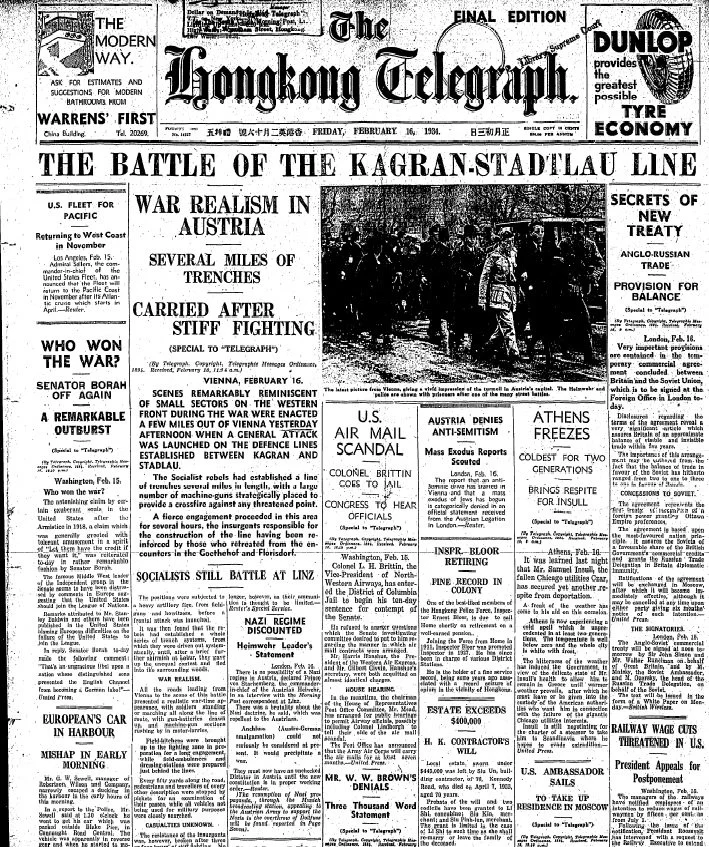
Photo credits: Tung Wah Group of Hospitals; The Hong Kong Telegraph (16 February 1934)